China Swarm Drones Achieve First Full 3D Typhoon Observation: Bee Colony Drone Array Captures Complete Typhoon Landfall Process From Multiple Altitudes Simultaneously
China Meteorological Administration uses bee colony drone swarm for first full-process three-dimensional typhoon observation, deploying coordinated UAV array to capture temperature, humidity, wind, and turbulence data.
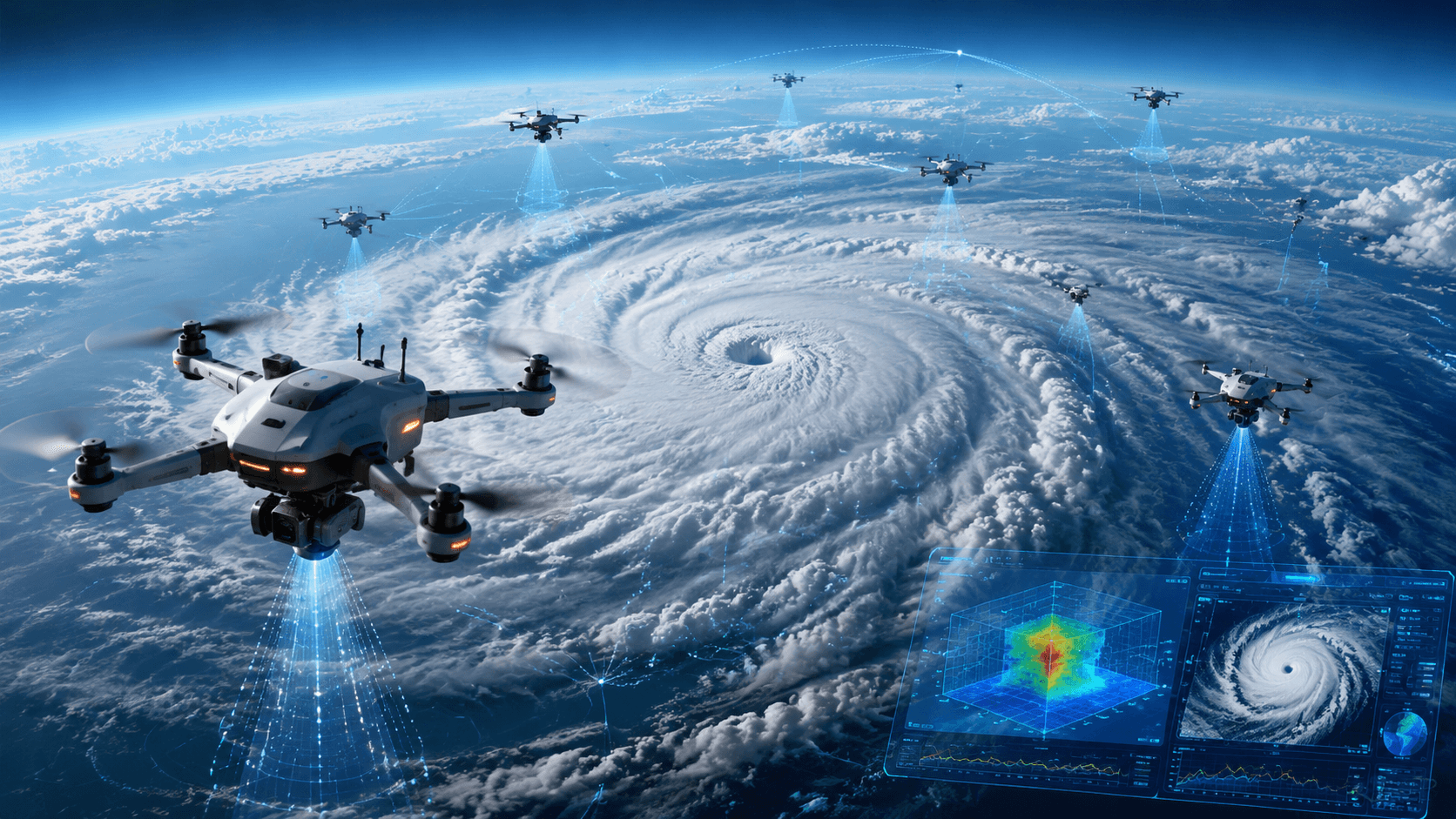
China has achieved a world first in meteorological observation by deploying a bee colony drone swarm for full-process three-dimensional monitoring of Typhoon Hongxia during its landfall. The China Meteorological Administration conducted the experiment at the Low-Alt Economy UAV Weather Assurance Field Test Base in Dapeng Peninsula, Shenzhen. Multiple meteorological sensor-equipped drones formed a coordinated observation array that simultaneously collected vertical profile data of temperature, humidity, wind field, and turbulence at multiple altitudes through the typhoon entire landfall process, marking the first application of swarm drone technology to complete typhoon lifecycle observation.
Unlike traditional single-drone operations, the swarm approach leverages multiple drones as a collaborative observation array. The coordinated formation performs multi-point, multi-layer atmospheric probing within the same airspace, achieving high-density sampling of the low-altitude three-dimensional space through inter-drone coordination. This compensates for the limitations of single-point detection that cannot capture the spatial structure of typhoon dynamics.
The swarm simultaneously recorded drone flight status parameters including attitude, trajectory offset, and power consumption, systematically exploring the meteorological constraint boundaries for safe drone operations in extreme weather conditions.The operational challenge is formidable. Typhoons generate extreme wind shear, heavy precipitation, and severe turbulence that would destroy conventional drones not specifically designed for such conditions.
The swarm drones required enhanced structural integrity, waterproofing, and control system robustness to maintain stable flight and data collection throughout the typhoon passage. The successful operation demonstrates that drone technology has matured beyond fair-weather applications to serve in the most demanding atmospheric conditions, providing critical data for typhoo
Đọc thêm từ Công nghệ

Google Messages : cette fonctionnalité cachée évite les impairs dans vos conversations
Avec des dizaines de conversations en cours, il vous est sans doute déjà arrivé d'envoyer la mauvaise réponse à la mauvaise personne. J'ai trouvé une solution pour éviter ce problème.

Wonder Festival Commemorated ‘Patlabor’ Amidst Blistering Heat
With the Japanese summer in full swing, with intense heat and humidity, fans made their way to Makuhari Messe to enjoy Wonder Festival 2026 Summer.

A Dark Horse Company Matures Under The SpaceX Flag
SpaceX’s Cursor acquisition highlights AI-native coding tools’ growing strategic importance beyond today’s most widely recognized AI companies.
The last Space Shuttle returned to Earth 15 years ago
So, how are those commercial replacements working out for you, NASA?