Trump hits Singapore with new 12.5% tariff that will affect one-third of its exports
Singapore is also subject to US investigations relating to structural excess manufacturing capacity and production.
Trump hits Singapore with new 12.5% tariff that will affect one-third of its exportsSign up now: Get ST's newsletters delivered to your inboxSingapore has rejected suggestions that it engages in unfair trade practises, including the use of forced labour in supply chains. PHOTO: ST FILEOvais SubhaniPublished Jul 24, 2026, 09:33 AMUpdated Jul 24, 2026, 09:34 AMSet as preferred sourceListenSummariseAbout one-third of Singapore’s exports to the US now face a new 12.
5% tariff due to a US probe on forced labour in supply chains.The tariff replaces an earlier 10% global levy and is part of broader US measures using Section 301, which may prompt legal challenges.Singapore denies using forced labour and has raised concerns with the US.
AI generatedSINGAPORE - About one-third of Singapore’s exports to the US are now subject to a new 12.5 per cent levy aimed at rebuilding President Donald Trump’s tariff regime that a court decision had undermined earlier this year. A US Federal Register notice published on July 23 (Washington time) listed Singapore among dozens of other countries that now face duties of between 10 per cent to 12.
5 per cent after a probe by the Office of the US Trade Representative (USTR) found them trading in goods produced with forced labour.Announcing the new levy US Trade Representative Jamieson Greer said: “The United States has had a forced labour import ban for nearly a century, and rigorously enforces it; it’s well past time for our trading partners to do the same.”The USTR investigation - which started in March and concluded in July - placed Singapore among the 45 economies that will face higher duties of 12.
5 per cent as they have failed to both adopt and effectively enforce the prohibition a US ban on goods produced with forced labour.The Straits Times has contacted the Ministry of Trade and Industry for comments.Goods from some 10 trading partners deemed to have adopted forced-labour restrictions will be subject to 10 per cent tariffs, including Mexico, the UK, Canada and India.
Goods from Japan, Switzerland and South Korea will also be taxed at 12.5 per cent, but in a way that complies with the trade agreements they reached with the US.Singapore has rejected suggestions that it engages in unfair trade practises, including the use of forced labour in supply chains, and has told the US that it does not condone such practises.
Foreign Minister Vivian Balakrishnan told reporters on July 23, after wrapping up a week of meetings at the ASEAN Foreign Ministers’ Meeting in Manila, that he had raised the matter during a bilateral meeting with US Secretary of State Marco Rubio.In June, the Ministry of Trade and Industry said that some exports will remain exempted, such as energy and energy products, pharmaceuticals and pharmaceutical ingredients, certain electronics, certain aerospace products, semiconductors, and metals used in currency and bullion.According to a Presidential memorandum issued by the White House, goods already facing Trump’s sector-specific tariffs – like steel and aluminium – will not be impacted.
Certain energy products and fertilisers will be exempt too, alongside goods covered by the US-Mexico-Canada free trade pact.The new tariff is part of a series of measures initiated to impose new and harsher tariffs after the US Supreme Court in February struck down the legal basis of Trump’s signature reciprocal tariffs, imposed in 2025. The new tariff replaces a 10 per cent global levy under Section 122 – imposed immediately after the court’s decision - which expired earlier this week.
Singapore, along with 15 other economies, is also subject to USTR’s investigations under Section 301 into acts, policies, and practises relating to structural excess capacity and production in manufacturing sectors.It is unclear when the findings of that probe will be released, or whether any future duties from that investigation would be stacked on top of those proposed under the forced labour investigation.Last week, Greer said in a Bloomberg Television interview that the excess capacity investigation is taking longer than the that into forced labour as the USTR is trying to make sure that the measure lives up to the letter of the law.
Experts believe the Trump administration used Section 301 of the Trade Act of 1974 as the legal basis for imposing the new tariff on trade in forced labour goods because it has no statutory expiration date or maximum percentage cap.Historically, measures imposed under this law have also proven far more resilient against judicial overturns.However, using the statute as a dragnet to apply blanket universal or multilateral tariffs to dozens of countries stretches the law beyond Congress’ intent.
Hence, the experts anticipate immediate lawsuits once the tariff takes effect.More on this topicSingapore seeks to avoid becoming collateral damage from US tariffs: Vivian BalakrishnanOvais Subhani is senior business correspondent at The Straits Times. He writes stories that demystify th
Đọc thêm từ Tài chính
HSBC agrees to US$2 billion deal to sell Singapore insurance branch to Allianz
HSBC has agreed to sell its Singapore life and health insurance business to Germany’s Allianz for S$2.7 billion (US$2.08 billion), with the deal expected to be completed in the first half of 2027, HSBC Group announced on Friday morning before the start of trading. The disposal is
Typhoon Noul to come closest to Hong Kong late Saturday into Sunday
Typhoon Noul is expected to come closest to Hong Kong between Saturday night and Sunday morning, according to the city’s weather forecaster, which is considering issuing the No 1 warning signal later on Friday. The tropical storm near the Philippines was officially named Typhoon
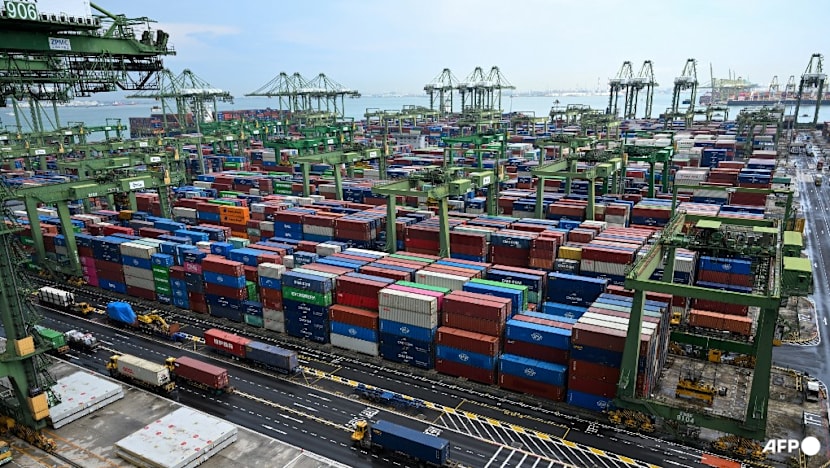
US hits Singapore with 12.5% tariffs, citing failure to ban imports produced with forced labour
The Ministry of Trade and Industry previously said that about one-third of Singapore's domestic exports to the US could be affected by the tariffs.