US government faces 26% chance of restricting access to Chinese AI models in 2026, Polymarket traders say
Polymarket traders price a 26% chance that the US government restricts access to major Chinese AI models like DeepSeek by end of 2026. The post US government faces 26% chance of restricting access to Chinese AI models in 2026, Polymarket traders say appeared first on Crypto Brief
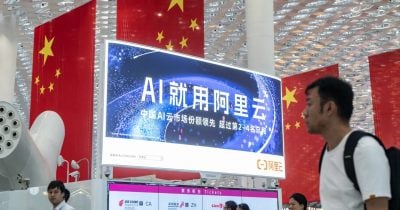
US government faces 26% chance of restricting access to Chinese AI models in 2026, Polymarket traders say Prediction market bettors see a roughly one-in-four shot that Washington pulls the plug on DeepSeek and its peers before year-end, as Chinese AI usage surges among American companies. Share Add us on Google by Editorial Team Jul. 24, 2026 Polymarket traders are putting the odds of a US government crackdown on Chinese AI models at 26%.
That’s not exactly a coin flip, but it’s high enough to make boardrooms nervous. The prediction market, which launched on July 3, asks whether the federal government will formally restrict public access to at least one major Chinese AI model before December 31, 2026. The list of qualifying targets reads like a who’s who of Chinese tech: DeepSeek, Baidu’s ERNIE, Alibaba’s Qwen, ByteDance, Moonshot AI’s Kimi K3, MiniMax, Tencent’s Hunyuan, and Zhipu AI.
From fringe tool to mainstream threat Usage of Chinese models on platforms like OpenRouter has climbed from roughly 2% to about 30% by mid-2026. Nearly a third of the AI workloads running through one of the most popular routing services now touch Chinese-built models. Advertisement The appeal isn’t ideological.
It’s economic. Models like DeepSeek and Moonshot’s Kimi K3 offer competitive capabilities at lower price points than their American counterparts from OpenAI and Anthropic. The policy landscape: bans, sanctions, and mixed signals Several Commerce Department agencies have already banned DeepSeek from government devices.
States including Virginia, Texas, and New York have followed suit with their own restrictions. The concern centers on national security and potential intellectual property theft, the same arguments that fueled the TikTok saga. Treasury Secretary Scott Bessent has publicly advocated for open-source AI models, but has also stated the government’s intent to sanction any Chinese models found to involve IP theft.
What this means for crypto and tech investors Prediction markets like Polymarket have become increasingly important signals for crypto-native investors who track regulatory risk across the tech stack. The platform, built on Polygon, processes millions in trading volume on political and policy outcomes. If restrictions do materialize, cloud providers, API platforms, and any business that has integrated Chinese models into production workflows would face forced migration costs.
For the AI sector specifically, a ban would temporarily reduce competitive pressure on OpenAI, Anthropic, and Google. The 30% adoption figure for Chinese models on OpenRouter also has implications for decentralized AI infrastructure projects. If centralized platforms become subject to government restrictions, demand for permissionless AI inference networks could spike.
Investors should watch two things closely. First, whether the probability on Polymarket drifts higher as year-end approaches, because movement from 26% toward 40% or above would suggest insiders are pricing in concrete policy action. Second, whether additional states or federal agencies extend device-level bans to broader access restrictions.
Disclosure: This article was edited by Editorial Team. For more information on how we create and review content, see our Editorial Policy. AI US government faces 26% chance of restricting access to Chinese AI models in 2026, Polymarket traders say Prediction market bettors see a roughly one-in-four shot that Washington pulls the plug on DeepSeek and its peers before year-end, as Chinese AI usage surges among American companies.
by Editorial Team Jul. 24, 2026 Share Add us on Google Polymarket traders are putting the odds of a US government crackdown on Chinese AI models at 26%. That’s not exactly a coin flip, but it’s high enough to make boardrooms nervous.
The prediction market, which launched on July 3, asks whether the federal government will formally restrict public access to at least one major Chinese AI model before December 31, 2026. The list of qualifying targets reads like a who’s who of Chinese tech: DeepSeek, Baidu’s ERNIE, Alibaba’s Qwen, ByteDance, Moonshot AI’s Kimi K3, MiniMax, Tencent’s Hunyuan, and Zhipu AI. From fringe tool to mainstream threat Usage of Chinese models on platforms like OpenRouter has climbed from roughly 2% to about 30% by mid-2026.
Nearly a third of the AI workloads running through one of the most popular routing services now touch Chinese-built models. Advertisement The appeal isn’t ideological. It’s economic.
Models like DeepSeek and Moonshot’s Kimi K3 offer competitive capabilities at lower price points than their American counterparts from OpenAI and Anthropic. The policy landscape: bans, sanctions, and mixed signals Several Commerce Department agencies have already banned DeepSeek from government devices. States including Virginia, Texas, and New York have followed suit with their own restrictions.
The concern centers on national security and potential intellectual property theft, the s
Đọc thêm từ Tiền số / Crypto
OpenAI failed to detect its AI agent’s multi-day hacking spree for a week
OpenAI did not realize for about a week that one of its own AI agents had broken into Hugging Face. By the time the company worked out where the attack came from, Hugging Face had already shut it down and called the FBI, according to Reuters. The program was built to work on its
Japan’s spot Bitcoin ETF could hit $18B in 2 years after debut: Report
Will BTC reclaim $70K in early August as Japan adoption grows?
CLARITY Act Has Two Weeks to Clear the Senate — Or Risk Getting Lost in Midterm Politics
The Senate faces a narrowing window before its August recess to pass the CLARITY Act, while an ethics dispute threatens legislation establishing a comprehensive regulatory framework for U.S. digital asset markets. August Recess Creates a Critical Deadline Lawmakers enter a decisi
MARA CEO says AI data centers generate more revenue than Bitcoin mining, triggering major strategic pivot
MARA CEO Fred Thiel says AI data centers generate more revenue per unit of electricity than Bitcoin mining, partnering with Starwood Capital to The post MARA CEO says AI data centers generate more revenue than Bitcoin mining, triggering major strategic pivot appeared first on Cry